Roads of Fear: Why Container-Trailer Accidents Demand a National Emergency Response
When Sierra Leone can declare a public health emergency after two confirmed cases of mpox, it should be capable of treating an estimated road death toll of more than a thousand people in a single year with the same urgency. Yet road deaths occur one by one, week after week, without the coordinated national response reserved for outbreaks. Why? Because we have chosen to treat them as isolated accidents rather than a continuing emergency.
Ask anyone who uses Sierra Leone’s highways, and they will describe the same thing: a particular kind of fear. It is the small act of glancing at the rear-view mirror when a container trailer suddenly appears behind. It is the moment of silence among passengers when a bus begins descending a hill behind a forty-foot container. It is the instinct to give the truck more space than any vehicle should need, because everyone has heard of the moment when one of these trucks failed to stop. This is what it means to live with roads of fear.
Dread has become commonplace on journeys between Freetown and the provinces. Because the deaths occur in different places and at different times, we rarely count them together. One crash dominates the morning news and is forgotten by evening. The cumulative toll is something we have chosen to overlook. But counted together, the pattern is clear: this is a national emergency we have decided not to name.
The World Health Organisation’s latest country profile estimates that 1,165 people died in road crashes in Sierra Leone in 2021, compared with 336 officially reported deaths. That amounts to 13.8 deaths per 100,000 people; in 2024, the UN Secretary-General’s Special Envoy for Road Safety described Sierra Leone’s rate as the seventh highest in Africa. The gap between estimated and reported deaths also exposes how incomplete the national picture remains. The figures are not merely large. They suggest a crisis that is both severe and undercounted.
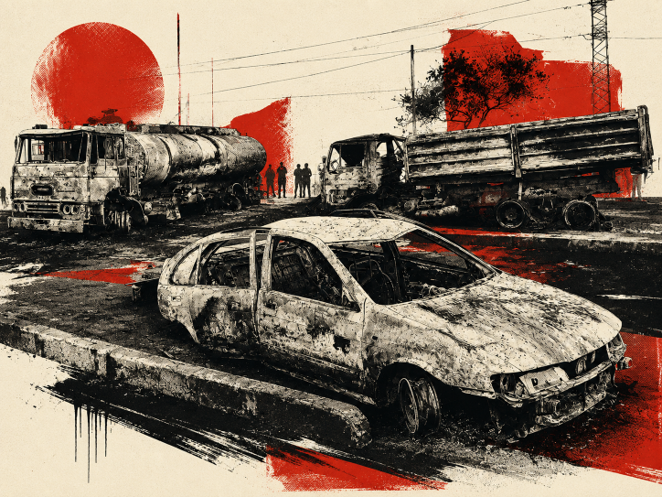
Now consider the particular danger posed by heavy commercial vehicles along the country’s haulage routes. At Rokel Village Junction on the Freetown-Waterloo Highway in May 2026, a truck carrying a forty-foot container lost control and collided with other vehicles, killing at least ten people. On the Makeni-Kamakwie Highway, a collision between a goods truck and a passenger vehicle killed five members of one family. In November 2021, a collision involving a fuel tanker at Wellington led to an explosion that ultimately killed more than 150 people. These were not identical crashes, but they shared one feature: a single failure involving a heavy vehicle became a mass-casualty event.
Now compare that pattern with how we respond to other threats. In January 2025, two confirmed mpox cases prompted the declaration of a public health emergency within days, and rightly so. We knew the procedure: mobilise leadership, establish a task force, fund the response, set targets, involve all relevant agencies and sustain the effort until the threat was contained. We did the same against Ebola in 2014 and cholera before that. Yet we have never applied comparable urgency to a road-safety crisis that WHO estimates kills more than a thousand Sierra Leoneans in a year. A disease threatening that toll would alarm us. When road crashes happen, we call it traffic.
Why Trailers – and Why a National Response
There are specific reasons for paying special attention to trailers, and none of them is emotional. First, container trailers can multiply casualties. A motorcycle crash is devastating, but a heavy truck that loses its brakes on a descent or carries an unsecured container can strike several vehicles and pedestrians at once. The difference is not that other road users matter less; it is the scale of harm a single failure can produce.
Second, haulage routes cross jurisdictions. A trailer that leaves Freetown unchecked may cause casualties in Waterloo, Makeni or on the road to Kamakwie. The response, therefore, requires national coordination among the port authorities, the Sierra Leone Road Safety Authority, the police, relevant ministries, transport operators and health services. Coordination does not emerge on its own. A national emergency response is designed to create it.
Finally, the problem is embedded in the national economy. These vehicles transport cargo imported through the Port of Freetown to destinations across Sierra Leone. Riches travel these roads; coffins return along them. In other words, we have accepted a transport system in which the movement of goods can cost the lives of people who travel beside these trailers or live along their routes. No one has voted for this deal.
What Must Be Done Now
Calling this a state of emergency should not be a slogan. It should trigger special working methods and measurable results.
There should be a presidential, time-bound task force with a defined budget, a deadline and publicly reported targets – not another policy launched in a hotel and quietly forgotten, but a mechanism measured by one outcome: fewer deaths and serious injuries.
Inspections should begin where cargo begins its journey: at the Port of Freetown and major freight depots. A trailer with defective brakes, bald tyres or an unsecured or improperly loaded container should never start its route. This must be reinforced by functioning weighbridges and enforcement of ECOWAS axle-load standards. Sierra Leone was still validating its national axle-load management framework in June 2026; implementation must now move quickly from policy to practice.
- Engineer the black spots.
- Known danger points such as Rokel Junction combine steep descents, congestion and frequent trailer traffic. They need escape ramps or arrestor beds on descents, redesigned junctions, enforced heavy-vehicle speed limits and barriers that protect pedestrians. Clearing the roadside and issuing statements after each disaster are not engineering solutions.
- Make accountability reach the corporation.
- If an overloaded or improperly loaded vehicle kills people, responsibility cannot end with the driver. The company that owned, loaded, dispatched or profited from the unsafe journey must also face investigation and, where fault is established, meaningful penalties.
- Build the trauma care that follows.
- The new burns unit at Connaught Hospital is a welcome investment, but Sierra Leone’s emergency and trauma capacity remains limited. Wellington showed how one bad night can overwhelm the system. A national road-safety response must prevent crashes, but it must also ensure that ambulances, trained emergency teams, trauma facilities and burns care are available when prevention fails.
None of this is beyond us. We have done more difficult things under harsher circumstances whenever we decided a threat was sufficiently grave. The roads of fear are not a natural phenomenon, nor are they an unavoidable price of being a poor country with a major port. They are the result of choices: weak enforcement, delayed investment and the acceptance of preventable deaths as the normal background of daily life. The deaths are already at emergency levels. What is missing is the decision to recognise them as such and to act with the urgency we already know how to summon.

Foday Augustine Bangura is an accomplished academic and administrative leader with extensive experience at the University of Makeni, where he has served in senior roles including University Registrar, Dean of Political Science and International Relations, and Deputy Registrar & Secretary to the Governing Council. He is pursuing a PhD in Educational Administration and Leadership, with research focused on university-community service policies in Sierra Leone.
The views and opinions expressed in this op-ed are solely those of the author and do not reflect the official position, policies, or views of any affiliated institution or organisation.
Copyright © 2026 Governance & Research Centre – University of Makeni