How Poor Governance Is Driving Sierra Leone’s Urban Crisis
In August 2017, after three days of heavy rain, a section of Sugar Loaf Mountain overlooking Freetown collapsed, sending mud, boulders, and debris through the informal settlement of Regent. The disaster killed over 1,000 people and left more people homeless. In July 2025, flooding in the hillside community of Col Wata claimed the lives of at least three family members, including a missing one-year-old girl. Between these tragedies, seasonal floods have repeatedly swept through homes in Susan’s Bay, Kroo Bay, and Dwarzak, turning drainage channels into channels of sewage and garbage. These are not isolated natural disasters. They are the predictable consequences of poor urban governance.
This article argues that Sierra Leone’s urban governance crisis, driven by unregulated settlement expansion, weak waste management, and chronic underinvestment in basic infrastructure, is not merely a planning or environmental problem but a growing public health emergency. It operates through multiple, overlapping pathways, such as environmental degradation that heightens exposure to floods and landslides, poor sanitation that accelerates the spread of disease, and institutional failure that leaves the urban poor most exposed. Without urgent and coordinated action, including enforceable land-use regulation, decentralised waste management infrastructure, and accountable urban governance, Sierra Leone’s cities will continue to endanger the health and lives of their most vulnerable residents.
Unregulated Settlements on Hazardous Land
Freetown is a coastal city of steep hillsides and low-lying shoreline, but many of its fastest-growing neighbourhoods occupy the terrain most vulnerable to disaster. More than 55 percent of Freetown’s built environment suffers from inadequate or nonexistent infrastructure, such as roads, drainage, and waste management. The weakness of the building permit system has allowed many houses to be constructed in areas prone to risks and hazards. The health implications are multidimensional and severe. Rapid urban expansion has pushed low-income households into informal settlements located in areas increasingly exposed to coastal flooding and landslides. Expanding informal neighbourhoods often sit in floodplains and have little access to public services and basic utilities. For example, only 30% of households have access to improved sanitation, and only 75% have access to improved water. The proliferation of informal settlements in areas susceptible to flooding and landslides is exacerbating the vulnerability of residents to disasters. Hazardous environmental conditions, poor waste disposal, and waste burning contribute to health problems at the neighbourhood level.
Blocked Drainages and Unmanaged Garbage
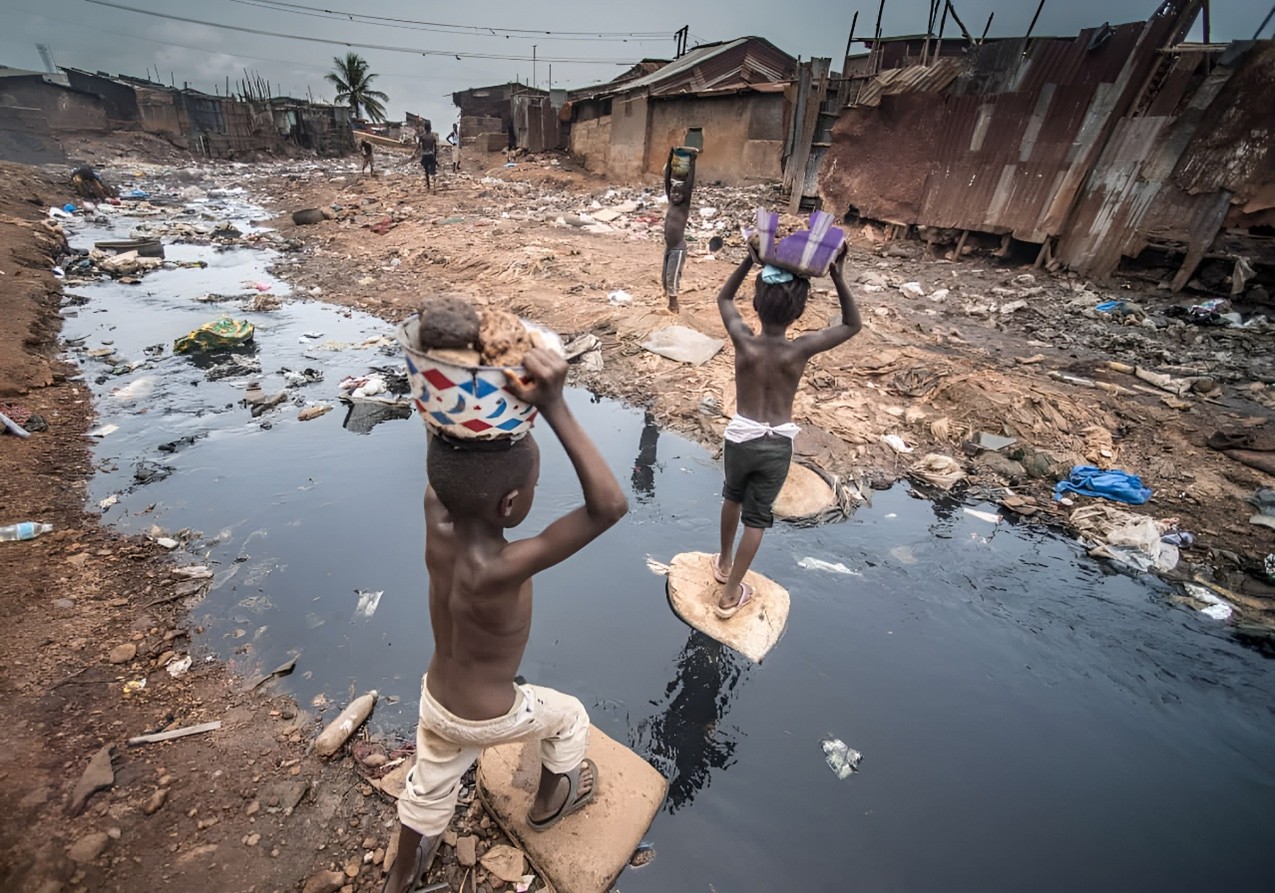
Freetown generates waste at a rate far exceeding its disposal capacity, yet the city lacks the basic infrastructure to manage it. For years, untreated waste flowed directly into the ocean, carried away by rainfall, tides, or time through open drainage systems. Improper waste management has severe implications for waterways. Notably, waste dumped in gutters and rivers clogs drainage systems, causing flooding during the rainy season. The resulting floods damage homes and infrastructure while increasing the risk of diseases such as malaria, cholera, and typhoid. Plastic waste also poses public health issues, as blocked drainage leaves water stagnant and creates a breeding ground for mosquitoes in a region where malaria is endemic.
In informal settlements, the absence of a well-planned and regulated waste management system significantly contributes to indiscriminate waste dumping, and the need for community-led initiatives to clear out the waste demonstrates the scale of the problem. For example, in July 2025, a six-day flood-mitigation campaign in Susan’s Bay, Kroo Bay, and Dwarzak mobilised approximately 1,000 volunteers and cleared approximately 50 truckloads of garbage from the streets and drainage systems. Yet even this extraordinary community effort only scratched the surface.
Furthermore, the waste-to-energy plant in Kingtom, operational since 2021, now treats over 20 percent of the city’s liquid waste, turning it into compost, biogas, and fuel, but the remaining 80 percent remains largely unmanaged. A $20 million project funded by the World Bank, intended to build a sanitary landfill and permanently close the hazardous Bormeh and Kingtom dumpsites, collapsed in October 2024. This failure was due to the central government’s failure to produce the required land documents, resulting in four years of delays and the eventual withdrawal of funding. The mayor of Freetown called the loss of this project a devastating setback for environmental sustainability and public health in the city.
The Health Effects
The combination of unmanaged waste, blocked drainage, and overcrowded informal settlements creates a perfect environment for the spread of infectious diseases. A 2023 cross-sectional survey of 4,871 households in three informal settlements, Cockle Bay, Dwarzark, and Moyiba, found that shared sanitation facilities were positively associated with higher healthcare utilisation, indicating the burden of sanitation-related illness. In these settlements, sanitation remains a major challenge, particularly access to decent toilets, due to constraints on land excavation in hilly areas or limited construction space. Limited access to toilet facilities often leads to the unsafe disposal of human waste, and some residents still practise open defecation, exposing themselves to an increased risk of infectious disease outbreaks. Hanging toilets connected to the sea or large drainages, poorly maintained pit latrines that overflow during the rainy season, and open defecation all contribute to the contamination of water sources. Sierra Leone’s fragile health system faces multiple overlapping crises, including inadequate infrastructure, workforce shortages, weak surveillance systems, and limited financial resources.
How the Urban Poor Pay the Price
Health impacts in Freetown’s informal settlements are not distributed equally. They fall heaviest on those already marginalised by poverty, gender, age, and insecure housing. Against a backdrop of limited state support, coping and access strategies are heavily mediated by people’s social positions and status, especially their ability to draw on support from social networks. For population groups such as the elderly and chronically ill, this creates further vulnerabilities, including social isolation, stigma, and vicious cycles of poverty. In the absence of insurance or savings, even minor healthcare expenses can escalate into significant financial burdens. For many residents, illness is not just a medical issue but also a trigger for deeper cycles of debt, displacement, and despair.
The healthcare utilisation study across three informal settlements identified strong settlement-specific patterns. Households with income from fishing, informal salaried work, and bike riding showed different healthcare-seeking behaviours both within and outside settlements. Food insecurity decreased healthcare utilisation within some settlements but increased it outside others, reflecting the complex trade-offs poor households face between immediate survival and health expenditures. Disability in households increases healthcare utilisation within settlements but reduces access outside, highlighting the mobility and affordability barriers that trap the most vulnerable in substandard local care. Urban areas like Freetown, Bo, and Makeni struggle to cope with the influx of people seeking economic opportunities, leading to growing poverty, inequality, and vulnerability.
Governance Failure
If health hazards and infrastructure deficits are the symptoms, then governance paralysis is the underlying cause. A 2024 study examining the relationship between decentralisation, urban planning, and flooding in Freetown revealed that the inefficient and ineffective decentralisation of governance functions to the Freetown City Council, largely due to a lack of political will and leadership, has significantly impeded effective flood management initiatives. The absence of coherent and enforceable spatial planning has further fueled uncontrolled urban expansion, placing greater pressure on infrastructure and accelerating environmental degradation. A broader study of disaster risk management and climate change adaptation policies across five informal settlements, including Kroo Bay, Susans Bay, Kulvert, Kolleh Town, and Dwarzack, revealed systemic deficiencies such as weak legal and institutional structures, poor inter-agency coordination, inadequate enforcement, limited access to data, corruption, political instability, and inadequate urban planning.
Conclusion
Sierra Leone’s urban crisis is no longer something that can be explained away as the unfortunate outcome of heavy rains, rapid population growth, or the pressures of poverty alone. It is the result of choices. More importantly, of failures to choose differently. When cities expand without planning, when drains remain blocked, when waste is left unmanaged, and when informal settlements are treated as inevitable rather than governable, the result is not simply urban disorder. It is sickness, displacement, and preventable death. The deepest injustice is that those who contribute least to this crisis, the poor, the elderly, women, children, and residents of informal settlements, are the ones forced to live closest to its dangers and suffer its harshest consequences. The question, then, is no longer whether Sierra Leone’s cities are in trouble. It is about whether the state is willing to confront the governance failures that have made cities so dangerous. A city should not become a place where rain turns into mourning, where garbage becomes disease, and where poverty determines who survives disaster.

Alhaji Osman Conteh is a master’s student at the University of Makeni and is a trained social worker. He is currently the Marketing and Sales Officer in the importing division at Salone Farm Development Company Limited.
The views and opinions expressed in this publication are solely those of the author and do not reflect the official position, policies, or views of any affiliated institution or organisation.
Copyright © 2026 Governance & Research Centre – University of Makeni